Postcode: 2540
Days of Work: 19
Dates: 26th May 2013 – 14th June 2013
People: Mark and Jenny (Host), Other Family Members
Having had a mixture of good and bad previous WWOOF placements, I was a bit fearful to head to my next place. But I took a deep breath and embarked on the five-hour train trip to get there, and I was greeted by a lovely couple. The first thing we did was head to the supermarket, and I got the chance to get to know these new people before I headed to their farm, and within about five-minutes of the shopping trip, I knew it was going to be alright! How right I was!
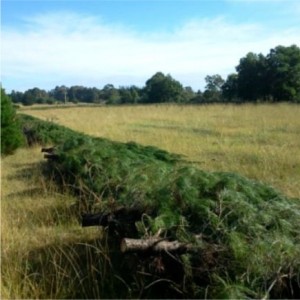 Tree Felling
Heading into winter, there was prep work aplenty for the coming spring season. Down in the ‘large tree field’ several had been ear-marked for felling. Most of the trees down there were over 7ft or taller, and while those size trees look good in a shop or small mall, they are not a good fit for the general living room. Therefore, only a handful are allowed to keep growing, the rest removed to allow planting space for the next generation of tree!
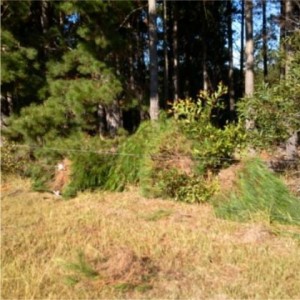 Tree Removal
So, once the trees were felled with the chain saw, they had to be removed from the main field into the woodland area that surrounded the field. The woodland area actually had trees that were over 10years old growing, and the newly felled trees would be allowed to decompose at the base of these giant trees, and thus provide extra nutrients for their continued growth. The size of these trees meant they acted as a wind break against the winds that whipped across the open fields, and would eventually be felled for timber.
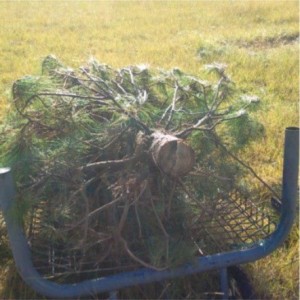 How Do You Move Something That’s Twice Your Size And Weight?
Good question! The simple answer is with a lot of hard work, energy and unknown physical strength. No, the truth of the matter is get the chainsaw again! We actually sawed the trees in half, although by the end of it all, I could have done with them being cut into quarters. But with the help of the trolley and some brute strength I did eventually get there. It took a lot longer than it looked like it should, but apparently I kept up a pace that was reasonable!
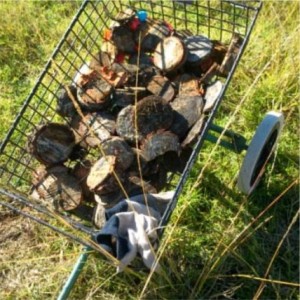 Stump Collection
With the trees removed, there remained a large collection of stumps that would be a trip hazard for the customers that came to choose their trees in six-months time, as well as a hazard to the mower when it went up and down the rows. So, out came the chainsaw again – fun times! Each stump was cut right down to the base so it was level with the ground, and then came the arduous task of collecting all the chopped off pieces. Once again, these were distributed along the floor of the woodland.
 Shaping
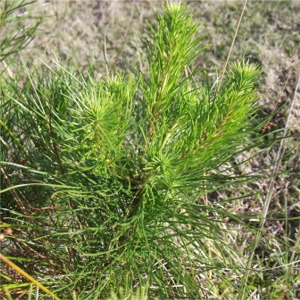
Interesting Fact: Christmas trees do not grow in Christmas-Tree-Shape! Yup, it’s true. They are just like any other tree and grow naturally! They actually require careful shaping and pruning in order to grow into the tradition shape that we have come to know and love about our trees. I was working on a field of young trees, so my shaping tasks could be carried out with just a pruner – the older trees required the chainsaw! But when I was eventually finished (this trip and the next one), I had a field of young trees that had the potential to be perfectly shaped once they reached their ideal Christmas Tree felling age!
 Trimming
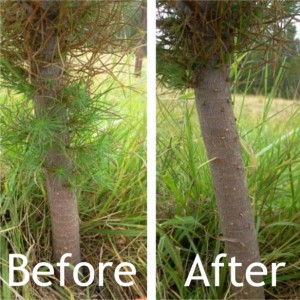
Just as important as shaping, because without trimming away the unnecessary branches and ‘fluffy stuff’, the trees cannot grow big and strong. By ‘fluffy stuff’ I mean the green leafy bits that are starting to grow at the bottom of the trunk. Because they are at the bottom and closest to the water/food source, they take everything first, with only a small amount then left for the main branches above. So, remove the fluffy stuff beneath the first main branches, and the water/food can go straight to them and they grow big and strong, just like a Christmas tree should be!
 Seedlings
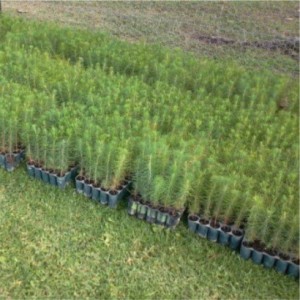
Towards the end of my first trip to the farm, the new seedlings were delivered. This year, they were in individual trays, which made it a lot easier to care for them. In previous years they have been delivered in cardboard boxes, and had to be planted straightaway. This time, because of the delivery method, we were able to keep them in their trays and allow them to grow bigger and stronger before eventually being planted into the ground (the majority were ground planted between my first and second visit). In the meantime, we had to keep them fed and watered to ensure healthy seedlings, so there was a daily watering, and occasionally twice a day if the heat and/or wind picked up!